Switching ink formulas isn’t something most print operators look forward to. The inside of an eco‑solvent printer is designed around a specific chemistry, so deciding to move from one ink family to another raises real questions about compatibility, maintenance and print quality. This piece explores whether you can switch from SS21 to BS4 or ES3, what the implications are, and how to choose the right solution for your shop. Throughout the article you’ll see hyperlinks to products like MIMAKI INKS and Mimaki SS21 Ink for sale that provide useful reference points and help ground the discussion in real‑world options.
Can I switch from SS21 to BS4 or ES3 ink? Getting to know the basics
At the core, SS21, BS4 and ES3 are all eco‑solvent ink sets designed for Mimaki’s wide‑format printers. They dry quickly, bond well to vinyl and other flexible media, and offer strong weather resistance. SS21 is the long‑time flagship formula—it delivers rich colour, fast drying and includes light cyan, light magenta, light black and orange channels for an extended gamut. BS4 is a more economical ink available in CMYK only and typically supplied in bulk bags rather than cartridges. ES3 is marketed as an office‑friendly alternative with lower odour but slightly less abrasion resistance. The differences aren’t just marketing; they translate into different solvent blends and hardware expectations. Therefore the answer to “Can I switch from SS21 to BS4 or ES3 ink?” is a qualified yes—you can do it, but it’s not as simple as swapping cartridges.
Understanding Eco‑Solvent Ink Technology
Eco‑solvent inks use solvent carriers that evaporate at moderate temperatures. They allow pigment particles to penetrate PVC and similar substrates, creating durable prints that can be laminated or cut almost immediately. Compared with true solvent inks, they emit fewer volatile organic compounds, making them safer for indoor environments. When you use MIMAKI INKS you’re working with a recipe that balances colour vibrancy and odour control. SS21 uses gamma‑butyrolactone (GBL), a solvent under increasing regulatory pressure, while SS22 and ES3 formulas remove GBL entirely and use recyclable packaging. Understanding these differences helps explain why mixing or switching inks requires careful planning.
Key differences between SS21, BS4 and ES3 inks

Colour and durability
Mimaki’s SS21 ink set remains the colour powerhouse. Its extended gamut with light colours and orange allows subtle gradients and vibrant oranges, and tests show minimal fading over three years. BS4 focuses on affordability rather than gamut—available only in CMYK, it still offers good outdoor durability but sacrifices the light colours and orange channel. ES3 targets office use: it produces less odour and is suitable for enclosed spaces but has lower scratch resistance. If you laminate most jobs, the abrasion differences may not matter; if you produce vehicle wraps or high‑touch decals, SS21’s toughness is a real asset.
Chemical composition and odour
SS21 uses GBL as part of its solvent blend, contributing to its fast drying and adhesion. SS22 and ES3 drop GBL entirely and adopt different co‑solvents to reduce odour. This shift reduces emissions by about 40 percent and earned Mimaki a sustainability award. BS4 also qualifies for GREENGUARD Gold certification but doesn’t use paper cartridges. These chemical differences are why the inks cannot be mixed—the formulas are chemically incompatible, and running one into lines coated with another will cause coagulation and clogging.
Compatibility and packaging
Compatibility varies by printer model. SS21 works with the widest range of Mimaki eco‑solvent printers, including CJV150, CJV300, JV150, JV300 and newer CJV330 and JV330 machines. SS22 is designed for CJV200 and JV330 series printers as a drop‑in replacement; no profile changes are needed. BS4 is offered mainly in bag systems for selected CJV and JV platforms, and it relies on bulk ink lines rather than cartridges. Because of these hardware differences, a “Can I switch from SS21 to BS4 or ES3 ink?” conversation must begin with a review of your printer’s configuration and whether it supports the target ink family.
Preparing your printer for an ink switch
Switching ink families is not a casual task. You must thoroughly flush the system, replace the dampers, clean the heads and adjust parameters in the service menu. A forum member who converted a JV33 BS model noted that you need to change the ink lines and dampers and perform extensive cleaning to remove the old BS4 ink. Because BS models expect bulk systems, the print head voltages and timings differ, so you may also need new chips or even a different printed circuit board. Another operator who switched from SS21 to ES3 described it as “an absolute pain” but said updating parameters and flushing the lines eventually worked. These firsthand accounts underscore that compatibility isn’t just about the cartridges; it involves firmware, chips and software profiles.
The flushing process is expensive because you must fill the system with cleaning solution and discard all residual ink. For BS4 conversions, you may need to invest in a bulk feed system. For ES3, certain Mimaki models require dedicated cartridge holders. It is wise to involve a technician familiar with Mimaki printers or use tools like chip emulators and custom ICC profiles to ensure accurate colour reproduction. Without proper preparation, the risk of clogging and damaged heads is high. Always factor the cost of downtime, cleaning fluids and potential hardware when considering whether to switch.
What is the difference between Mimaki ES3 and SS21?
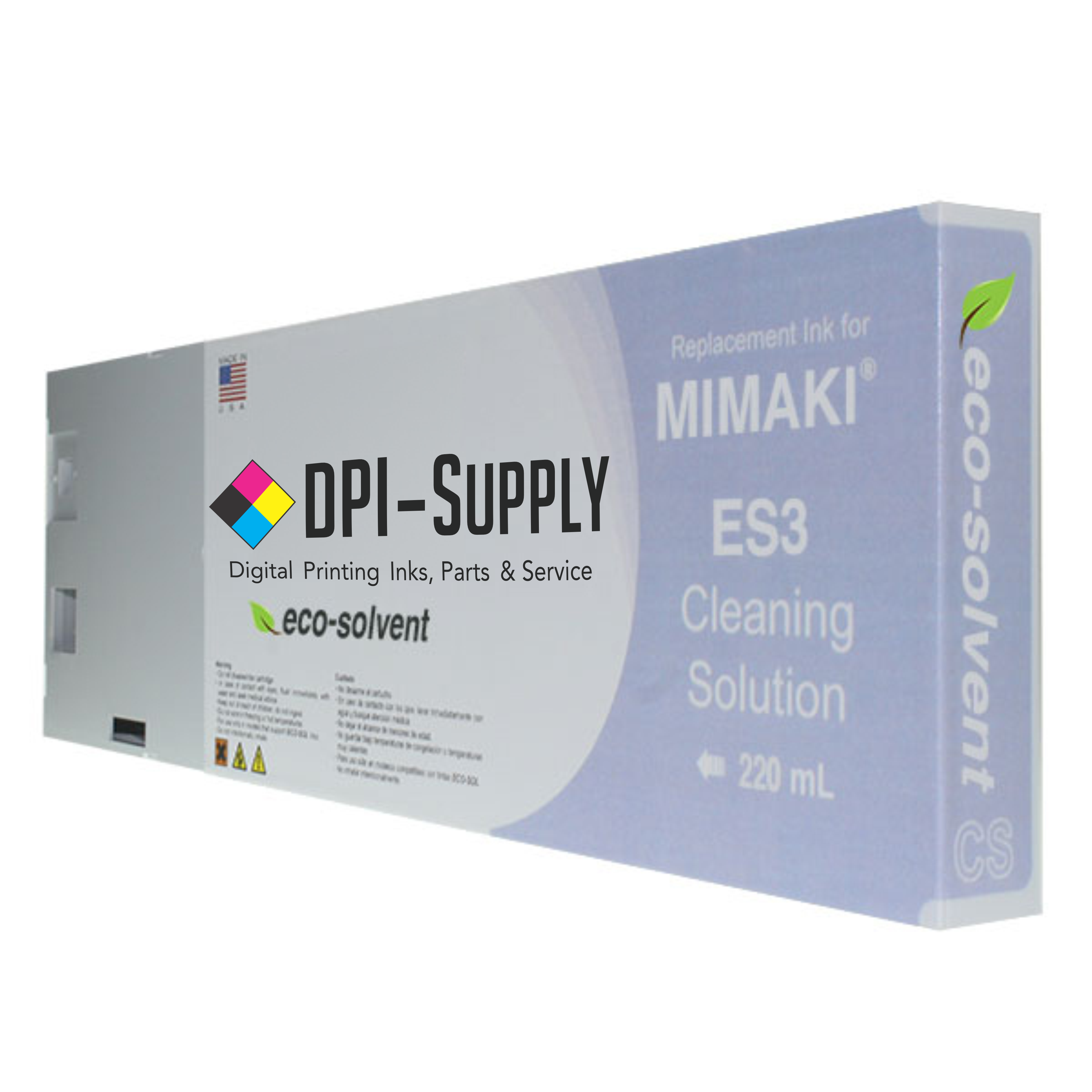
ES3 Mimaki Printer ES3 440ml Replacement Ink and SS21 are both eco‑solvent inks, but their strengths differ. ES3 is positioned as a lower‑odour, office‑friendly ink that performs well in enclosed spaces. It offers the same core colours (CMYK plus light cyan, light magenta and light black) but omits orange. Its odour control makes it suitable for schools, hospitals and retail spaces. SS21, by contrast, is formulated for durability and scratch resistance and includes orange for a broader colour gamut. Operators often laminate ES3 prints to compensate for its reduced abrasion resistance, whereas SS21 prints can survive more handling unprotected. Switching between ES3 and SS21 requires a full system flush and may involve different print profiles. Ultimately the choice depends on whether indoor air quality or ruggedness is more important in your workflow.

Can I use different ink in my Sawgrass printer?
Sawgrass sublimation printers (such as the SG500 and SG1000) can run different inks—SubliJet‑UHD, EasySubli and ChromaBlast—but switching between them is discouraged. An article from Coastal Business explains that while it is technically possible to switch, doing so will void your warranty and requires a full flush of the ink system. Flushing wastes hundreds of dollars’ worth of ink and cleaning supplies, so most vendors recommend purchasing a second printer if you need a different ink. This advice mirrors the Mimaki world: chemical incompatibility and hardware differences make ink changes expensive and risky.
What happens if you use regular ink for sublimation?
If you attempt sublimation printing with standard dye or pigment inks, the results will be disappointing. Sublimation papers are coated to absorb ink that will vaporize under heat, allowing it to bond permanently with polyester or polymer‑coated substrates. Regular inks do not sublimate; they remain in liquid form and either smudge or fail to transfer. A heat‑transfer supplier notes that regular inks produce dull, washed‑out colours, ineffective transfers and increased waste. The colours lack vibrancy, the prints may run or smear, and any image that does transfer will fade quickly. In short, regular ink undermines the advantages of sublimation and wastes time and materials. For the best results, stick with the ink type your printer is designed to use.
What ink can I use for Sawgrass SG500?
Sawgrass SG500 printers are versatile, but choosing the right ink depends on the substrates you intend to decorate. SubliJet‑UHD is the standard sublimation ink for SG500 and SG1000 printers. It produces vibrant transfers on a wide range of hard and soft substrates—mugs, mouse pads, photo panels, socks and T‑shirts—and is the most versatile option. EasySubli is a collaboration between Sawgrass and Siser; it works with EasySubli heat‑transfer vinyl, allowing you to decorate cotton and dark garments that sublimation alone cannot. ChromaBlast is not a sublimation ink at all; instead it bonds with 100 % cotton when pressed with its own transfer paper. Each of these inks is formulated for specific applications, and switching between them triggers the same problems mentioned earlier—voided warranties and mandatory flushes. For this reason, Sawgrass users typically dedicate each printer to a single ink family.
Using a Mimaki Printer? Choosing Between SS21, SS22, and BS4
The decision about which ink to run ultimately ties back to your printer model, budget, workflow and environmental goals. SS21 remains a dependable workhorse for legacy CJV150 and JV300 machines, delivering rich colours and long‑term outdoor durability. SS22 was introduced as a greener alternative; it removes GBL and uses recyclable paper cartridges. It is designed as a drop‑in replacement for newer CJV200 and JV330 printers and offers the same performance as SS21. BS4 is the budget option—offered primarily in CMYK, it dries quickly and is suitable for high‑volume, short‑ to medium‑term signage. For a deeper dive into how these ink families compare, the DPI Supply article Using a Mimaki Printer? Choosing Between SS21, SS22, and BS4 provides more detail.
Feature comparison table
| Ink | Key features | Best for |
|---|---|---|
| SS21 | Rich colours; fast drying; strong scratch resistance; CMYK + light colours + orange | Legacy Mimaki machines; vehicle wraps; long‑term outdoor signage |
| SS22 | GBL‑free; reduced odour; recyclable paper cartridges; matches SS21 performance | Newer printers (CJV200, JV330); environmentally conscious shops; schools and hospitals |
| BS4 | Quick drying; excellent weatherability; cost‑effective; CMYK only | High‑volume, budget‑driven production; short‑ to medium‑term signage |
This table summarizes the core strengths of each ink family. It doesn’t capture every nuance—for example, Mimaki SS21 Ink will still be your go‑to for orange‑rich graphics, while BS4 may require additional colour profiling—but it helps frame the conversation. When you see MIMAKI INKS promoted at a discount, remember that price is only one variable.
Choosing the right ink for your business

Choosing an ink is less about which formula is “best” and more about what aligns with your equipment and business goals. If you own a legacy CJV150 or JV300 and require maximum durability, SS21 is the proven workhorse. If you operate newer CJV200 or JV330 series printers or prioritise indoor air quality, SS22 offers the same performance with greener chemistry and recyclable packaging. Cost‑sensitive operations producing medium‑term signage may prefer BS4, especially when high‑volume runs make the lower price per millilitre attractive. If you print in an office or school setting, ES3 may be worth considering despite its reduced abrasion resistance. For sublimation‑only workflows, Sawgrass printers paired with the right ink—SubliJet, EasySubli or ChromaBlast—provide targeted solutions that shouldn’t be mixed.
When customers ask me “Can I switch from SS21 to BS4 or ES3 ink?” I remind them that it’s possible but rarely cost‑effective. The cleaning process is messy, and the risk of downtime or head damage is high. Usually the better move is to stick with the ink family your printer was designed for or invest in a second printer if you need another formula. By taking the time to understand the chemistry, compatibility and maintenance requirements of each ink, you can make a decision that keeps your business running smoothly and your prints looking vibrant.