When comparing Chinese DTF printers vs. Japanese DTF printers, Chinese models usually win on upfront cost, while Japanese-brand systems generally offer stronger dealer support, documentation, automated maintenance, and more predictable service. For a commercial print shop, the better value depends less on the country name and more on uptime, parts access, printhead protection, training, and total cost over several years.
DPI Supply owner Monty Hand has worked in printing since he was 20, spent 38 years in screen printing, entered digital ink in 2010, and later became a certified Mimaki, Roland and Mutoh technician. That experience has made him much more interested in what happens after the sale than what is printed on the price tag.
Chinese DTF Printers vs. Japanese DTF Printers: Cost, Reliability, and Support Compared
Chinese-built DTF equipment covers a huge range. Some machines are inexpensive direct-import units with limited documentation, while others are sold through U.S. dealers with training, parts inventories, RIP software, and service plans. Many also use Epson i1600 or i3200 printheads, so a “Chinese printer” may still contain major Japanese components.
Japanese brands such as Mimaki, Roland DG, Mutoh and Epson usually take a more integrated approach. The printer, ink system, firmware, maintenance routines, software, warranty, and dealer network are designed as one ecosystem. That tends to raise the purchase price, but it can remove variables that become painful during daily production.
| Factor | Chinese-Built DTF Printer | Japanese-Brand DTF Printer |
|---|---|---|
| Upfront cost | Usually lower | Usually higher |
| Parts | Availability varies | Structured dealer/OEM channels |
| Support | Depends heavily on seller | Established dealer/manufacturer support |
| Maintenance | Varies by machine | More standardized and automated |
| Best fit | Budget-focused, technical shops | Shops prioritizing uptime and support |
What is the most cost-effective DTF printer?
The most cost-effective printer is not automatically the cheapest. It is the machine that produces the volume you need with the lowest practical combination of labor, wasted film, failed prints, downtime, replacement parts, ink, and most important, service.
Upfront price is only one line item
Current Japanese-brand pricing shows why total cost matters. Epson lists its 35.4-inch SureColor G6070 at $14,995 MSRP, Mimaki lists the TxF300-75 at $15,995, Roland’s 30-inch TY-300i starts at $23,195 and the Mutoh XPD-924D 24" printer sold by STS is $24,995.
Lower-priced DTF printers can make sense for a startup or technically capable shop. Before buying, price the complete system: printer, RIP, curing equipment, ventilation, ink, film, powder, heat press, freight, training, spare parts, and service.
Our guide, Buying Your First DTF Printer? The DTF Ink, Film, Powder, and Supplies You'll Need, can help map out those additional costs.
What is the best Chinese DTF printer?
There is no single Chinese DTF printer we would call the best for every shop. The better question is: who built it, who supports it in the United States, which printheads and electronics does it use, and how quickly can you get replacement parts and service?
Look for proven white-ink circulation, scheduled cleaning, head-strike protection, accessible service components, and a dealer that stocks common failure items. Ask who actually performs technical support. If the only support path is messaging overseas and waiting for another time zone, that low purchase price deserves a second look.
Monty has seen inexpensive equipment become expensive when printheads become consumables. A quality printhead can cost well over $1,000 depending on the head and machine. Saving money up front does not help if poor maintenance or weak support has you replacing heads every few months.

Which printer has the least amount of problems?
No DTF printer is maintenance-free because white pigment ink creates a demanding environment. Better machines reduce risk with circulation systems, automated cleaning, nozzle monitoring, controlled capping, and software that tells the operator what needs attention.
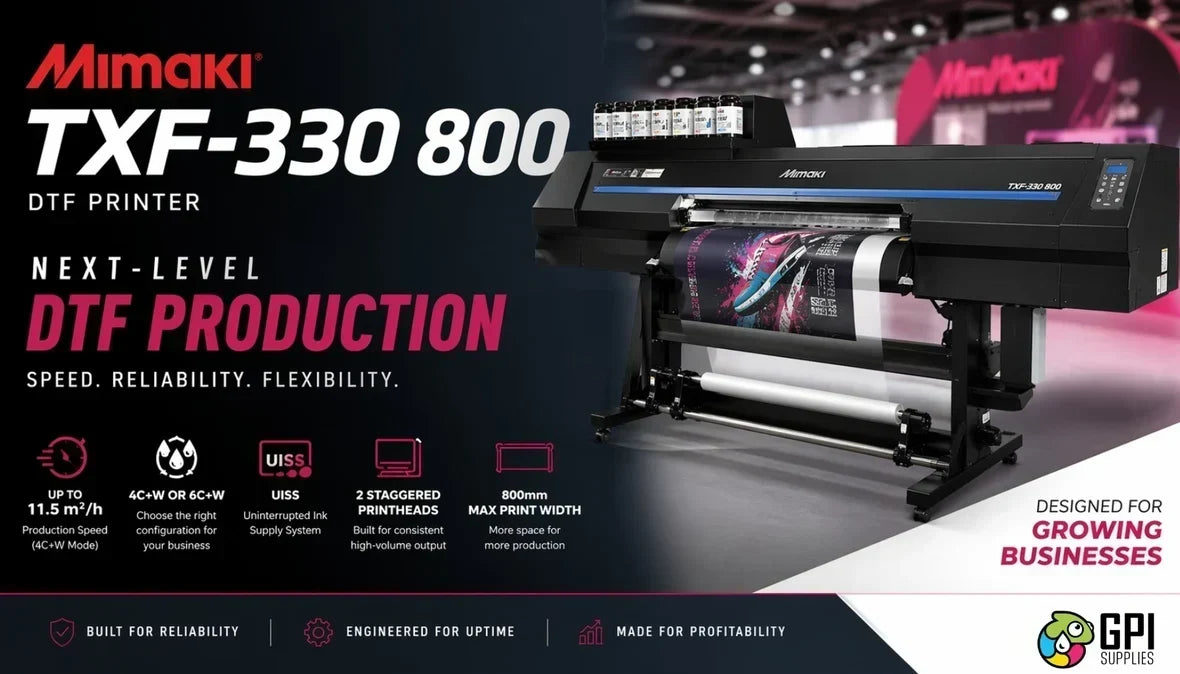
This is an area where established Japanese systems often justify their price. Mimaki uses white-ink circulation, nozzle checking, and nozzle recovery on its TxF line. Epson’s G6070 includes automated maintenance and nozzle verification, while Roland’s TY-300i includes white-ink management and automated maintenance features, STS XPD-924D has it's own white recirculation system.
Maintenance still decides uptime
Operator habits can defeat excellent engineering. Monty and two technicians he works with have a simple rule: “Did you run it? Clean it.” If a printer ran today, it should be cleaned today.
That comes from years of working around digital equipment. Ink is being jetted from the printhead at high speed, and not everything ends up exactly where you want it. Keeping the carriage, capping area, and other maintenance points clean can prevent a small issue from becoming an expensive repair.
What is the fastest DTF printer on the market?
“Fastest” changes constantly and means little unless machines are compared at similar print quality, pass count, width, and white-ink coverage. A draft-mode number is not the same as a production-mode number.
Among current mainstream Japanese systems, Roland reports the TY-300 platform at about 117 square feet per hour in recommended production mode and more than 188 square feet per hour in a faster four-pass mode. Mimaki rates the TxF300-75 at roughly 108 square feet per hour, The STS XPD-924D rated at 145 square feet per hour in production mode and 188 in a faster 3 pass mode.
Chinese production machines can also be extremely fast, especially systems using multiple i3200 printheads. The number worth asking for is the speed at the print mode you would actually sell to a customer.
A fast printer also needs a DTF powder shaker that can keep up. Otherwise, the printer simply moves the bottleneck to powdering and curing.

Why support can matter more than the purchase price
Downtime is one of the least discussed numbers in equipment shopping. The U.S. Bureau of Labor Statistics reported about 338,500 jobs in printing and related support activities in August 2026, reinforcing that this is a real production industry where labor, scheduling, and uptime matter. The U.S. Bureau of Labor Statistics printing-industry data provides a broader look at the industry.
If a printer goes down during a large order, the cost is not only a repair invoice. You may pay employees who cannot produce, miss shipping deadlines, outsource transfers at rush pricing, or lose repeat work.
A Japanese-brand machine with a local authorized dealer may therefore be cheaper in practice than a lower-priced machine with slow parts and remote-only troubleshooting. That does not mean every Chinese system has poor support. Some U.S. distributors do an excellent job. The Mimaki, Roland, and Epson DTF printers all require a service technician to replace the print head or heads. The STS uses the i3200 printheads and the end user is able to replace them without a service technician. Check what a print head will cast you. You will be replacing them at some point.
The key is buying the support structure, not just the chassis.
Who makes the best DTF prints?
The best DTF prints come from a complete process, not a flag on the machine. Printer calibration, ink chemistry, film coating, powder consistency, curing temperature, RIP settings, color profiles, and heat-press technique all affect the finished transfer.
Monty has spent years testing alternative inks because he does not believe “cheaper” has to mean lower quality. With DTF, he is especially cautious because white water-based ink can look fine initially and then reveal stability problems after weeks of production.
He has tested multiple DTF inks that seemed fine for a couple of weeks before the white began changing or printhead problems appeared. That is the kind of issue you do not see during a five-minute equipment demonstration.
A good Commercial DTF printer should therefore be judged after repeated production, not one impressive demo sheet. Ask to see solid white under bases, gradients, skin tones, small text, heavy coverage, and repeat jobs printed days apart.
What is the lifespan of a DTF print?
A properly produced DTF transfer can remain attractive for dozens of wash cycles, but there is no honest single lifespan for every shirt. Film, adhesive powder, ink, cure, press settings, fabric, washing temperature, detergent, and dryer heat all change the result.
Independent testing cited by Roland found TY-300 output maintained fine details, color, and stretch performance through 20 wash-and-tumble-dry cycles. Other commercial DTF wash testing commonly targets 40 to 50 or more washes when transfers are correctly produced and cared for.
This is another reason not to judge a printer by a fresh transfer alone. A beautiful print on day one does not tell you how the ink, powder, and film combination will perform after repeated washing.
The surrounding workflow matters too. A DTF flatbed cutter, accurate heat press, stable curing system, and repeatable finishing process can help maintain consistency after printing.
Japanese printer or Chinese printer: which should your shop buy?
Choose a Japanese-brand DTF system when downtime is expensive, you want a documented service path, multiple employees will operate the equipment, or your shop does not want to become its own repair department. The higher entry price can buy predictability.
Choose a Chinese-built system when lower capital cost matters, you are comfortable troubleshooting hardware, and you have verified that the U.S. seller stocks parts and provides real technical support. For the right operator, that can be a strong value.
Monty’s experience leads to a simple buying philosophy: test what matters and maintain what you buy. He has applied that same approach to the inks DPI Supply sells. Products have to prove themselves before he is comfortable putting his name behind them. He has printers that have been running for over two years on the same white print heads, because the ink matters.
A printer is not a bargain because it is cheap. It is a bargain when it keeps making sellable work.
The bottom line
Chinese DTF printers vs. Japanese DTF printers is ultimately a total-cost-of-ownership decision. Chinese equipment can lower the barrier to entry and offer impressive production capabilities, while Japanese systems often provide a more mature combination of engineering, automation, warranty, documentation, and dealer support.
Before purchasing, ask for a live production demo, maintenance schedule, replacement-part list, printhead price, warranty terms, technician response process, and realistic production speed. Then calculate what one full day of downtime costs your shop.
That number may tell you more than the printer’s sticker price ever will.