Eco-Solvent Ink vs UV Ink: Which Is Better for Your Print Shop? The better choice depends on what you print. Eco-solvent ink is often the stronger fit for signs, banners, decals, wraps, and other flexible graphics, while UV ink opens the door to rigid materials, specialty effects, product decoration, and jobs that need immediate curing.
Neither technology is automatically “better.” The real question is which ink system matches your equipment, media, customers, and production volume. That distinction matters because a low ink price means very little if the ink is wrong for the printer or the applications your shop sells every day.
DPI Supply owner Monty Hand has seen that firsthand. He spent decades in screen printing and has worked in the digital ink business since 2010. He also became a certified Mimaki technician and later a certified Roland technician, so his view of ink has always been practical: judge it by how it runs, how the color performs, and what it costs the shop over time.
What Is Eco-Solvent Ink?
Eco-solvent ink uses a relatively mild solvent carrier to deliver pigment to compatible print media. It is widely used in commercial sign and graphics production because it works especially well with common flexible substrates such as adhesive vinyl, banner material, printable films, and certain papers.
For many shops, that makes eco-solvent a dependable workhorse. Think vehicle graphics, storefront decals, wall graphics, banners, labels, posters, and general sign production. It is particularly attractive when a shop needs one machine to handle a broad mix of roll-fed graphics.
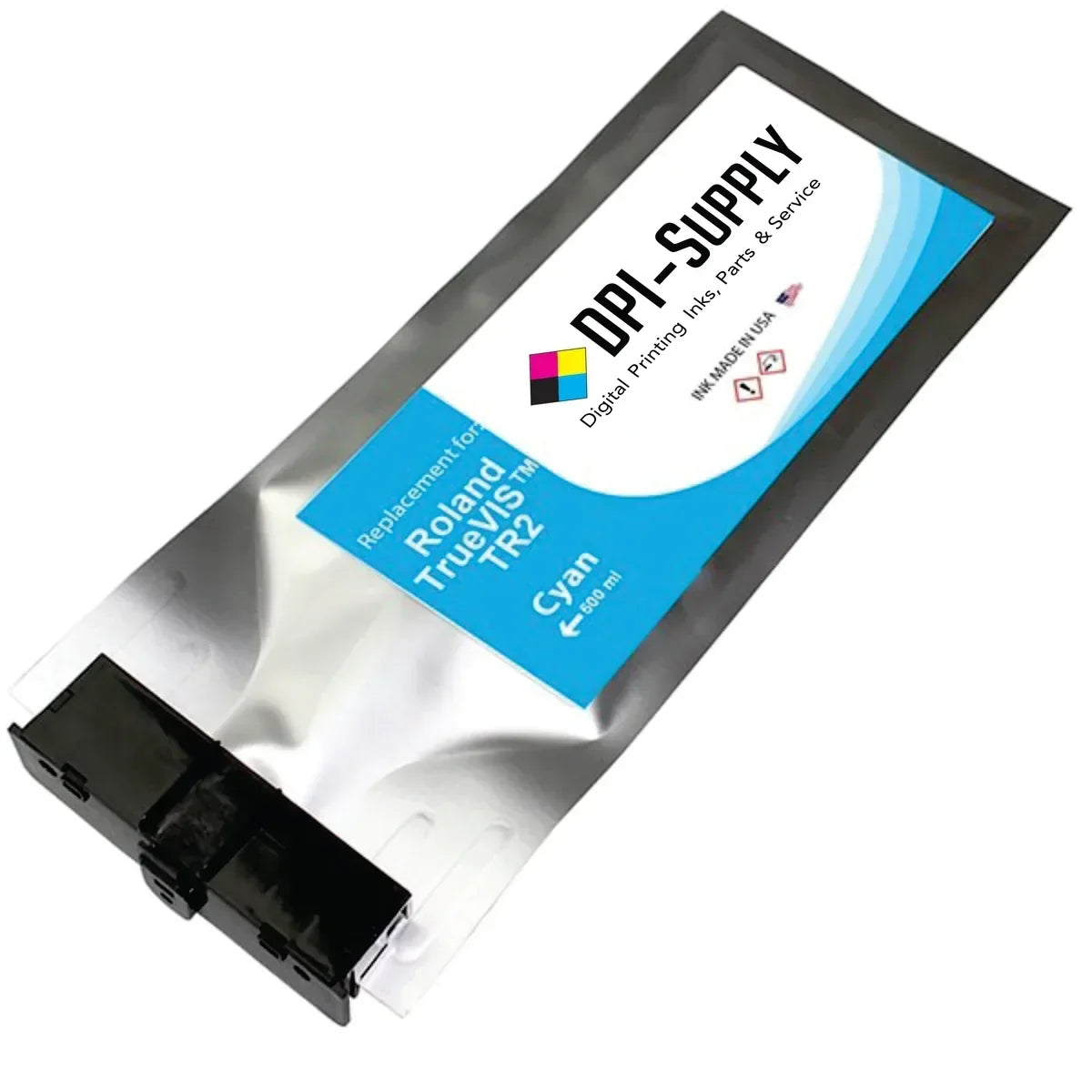
Eco-solvent printing is also familiar territory for many Roland, Mimaki, and Mutoh users. Shops comparing replacement options can review Roland and HP Ink Solutions for Professional Printers when evaluating compatible ink choices for existing production equipment.
Where Eco-Solvent Ink Makes the Most Sense
Eco-solvent is strongest when your business revolves around flexible graphics. If most jobs start with a roll of vinyl or banner material, there may be little reason to add the cost and complexity of a different ink platform unless customers are asking for applications you cannot currently produce.
Drying time still matters. Depending on the printer, media, ink coverage, finishing method, and laminate, a print may need time before it is ready for the next production step. That is different from UV ink, which is cured during the printing process.
For shops comparing eco-solvent with stronger traditional solvent formulations, DPI Supply also has a more focused guide: Eco-Solvent Inks vs. Solvent Inks: What’s the Difference, and Which One Should You Choose?.

What Is UV Ink?
UV ink works differently. The printer lays down ink and UV lamps cure it almost immediately. Instead of relying on evaporation and absorption in the same way as solvent-based systems, the ink is hardened on the surface as part of the printing process.
That changes what a print shop can offer. Depending on the printer, UV systems can print on vinyl and film, but they can also print directly onto rigid or three-dimensional materials such as acrylic, plastic, wood, metal, promotional products, signage panels, and other specialty substrates.
UV technology can also support features that are difficult to reproduce with a standard CMYK eco-solvent workflow. White ink can help when printing on clear or dark materials, while gloss or varnish channels on certain machines can add texture, highlights, or dimensional effects.
Print shops exploring this category can compare UV and Specialty Ink Options for Commercial Applications alongside the requirements of their exact printer and job mix.
Eco-Solvent Ink vs UV Ink: Which Is Better for Your Print Shop?
The simplest way to compare the two is by looking at what needs to leave your shop at the end of the day. A wrap-focused sign company has very different requirements from a business printing branded tumblers, acrylic displays, packaging prototypes, or rigid signs.
| Consideration | Eco-Solvent Ink | UV Ink |
|---|---|---|
| Best fit | Flexible signs and graphics | Rigid, flexible, and specialty applications |
| Common media | Vinyl, banners, films, paper | Acrylic, plastic, wood, metal, vinyl, film |
| Ink handling after printing | May require drying/outgassing time | Cured during printing |
| Specialty effects | Depends on printer and ink set | White, gloss, texture, and primer may be available |
| Production advantage | Proven roll-to-roll sign workflow | Fast finishing and broad substrate range |
| Main buying question | Does it match your media and printer? | Does it match your objects, substrates, and curing system? |
The table makes UV look more versatile, but versatility alone does not make it the better investment. If 90% of your revenue comes from banners, decals, and vehicle graphics, the ability to print on a wooden plaque may not improve your bottom line. Capacity should follow demand.
Think About the Entire Production Workflow
Ink choice should never be separated from the printer. Monty’s experience selling alternative ink started with learning the equipment itself. Before he became comfortable recommending products, he trained as a technician, tested inks, watched color performance, and paid attention to how they behaved over time.
That is important because compatible ink is not simply a question of finding the cheapest cartridge that fits into a slot. Color gamut, viscosity, adhesion, curing or drying behavior, chip compatibility, and long-term reliability all matter. A bargain stops being a bargain quickly when it creates reprints or downtime.
That is also why High-Quality Alternative Inks for Consistent Printing should be evaluated according to the specific printer platform and application rather than price alone. The goal is consistent production, not the lowest number on an invoice.

Maintenance Matters With Either Ink System
One of Monty’s most useful pieces of advice has nothing to do with choosing eco-solvent or UV. It is his simple maintenance rule: “Did you run it? Clean it.”
That comes from years of seeing what happens inside commercial printers. Not every droplet ends up exactly where a shop owner wants it. Ink mist and residue can collect around printheads, carriages, caps, wipers, and other components. Ignoring that buildup eventually shows up in print quality or equipment reliability.
UV systems bring their own maintenance requirements, especially around white ink, curing systems, and components exposed to ink. Eco-solvent printers also need consistent cleaning and proper cap, wiper, and printhead care. Whichever technology you choose, build maintenance into the daily production schedule instead of waiting for visible problems.
Do Not Judge Alternative Ink by Price Alone
Monty’s early experience with alternative inks was not perfect. He tested products from multiple suppliers and found that some simply did not perform well enough. That changed when he found formulations that could produce color and outdoor performance that held up against the OEM products his customers already knew.
That experience is especially relevant for a shop considering a switch. Third-party ink can create meaningful savings, but the supplier and formulation matter. Monty points to customers who moved away from expensive OEM ink after price increases and continued buying the alternative because the results worked for their production.
A print shop should look for proven compatibility, stable color, reliable jetting, and support from someone who understands the printer. Shop Compatible Printing Inks and Supplies based on your equipment first, then compare cost.
Which Ink Is Better for Signs, Wraps, and Decals?
For a traditional sign shop built around vinyl, banners, decals, wall graphics, and vehicle graphics, eco-solvent is often the more natural fit. The equipment and media ecosystem is mature, and many printer/cutters are designed around exactly this kind of work.
Eco-solvent also makes sense when contour cutting is a major part of production. A shop can print a roll of decals or graphics, cut them, weed or laminate as needed, and move through a familiar sign-production workflow.
If that describes most of your orders, changing technologies simply because UV is newer or more versatile may not solve a real business problem.
When UV Ink Can Expand What You Sell
UV becomes compelling when customers regularly ask for work outside a standard roll-media workflow. Printing directly on rigid boards, acrylic pieces, promotional items, packaging samples, or specialty materials can create new revenue streams without transferring a graphic from another material.
Immediate curing can also shorten certain workflows because the output is ready for handling much sooner. For shops with tight turnaround requirements, that can be a meaningful production advantage.
Specialty ink channels may matter too. White and gloss can turn a basic CMYK job into something more premium, particularly on clear, dark, or textured materials. For a manufacturer’s overview of how eco-solvent and UV technologies differ, see Roland DG’s Digital Printing 101 guide.

Ask These Questions Before Choosing
Before buying a printer, switching ink, or expanding into another technology, start with the work your customers actually order.
- What substrates account for most of our current revenue?
- Are customers asking for rigid or direct-to-object printing?
- Do we need white, gloss, primer, or other specialty ink channels?
- How important is immediate curing to our turnaround time?
- What finishing steps happen after printing?
- How much does ink cost per sellable job, not just per cartridge?
- Can our team maintain the printer correctly every day?
- Is the ink specifically compatible with our printer model and configuration?
Those questions are more useful than simply asking whether UV is better than eco-solvent. A print shop earns money from finished jobs, not from ink technology by itself.
The Better Ink Is the One That Fits Your Shop
Eco-solvent remains a strong choice for shops focused on flexible signs, decals, wraps, banners, and general wide-format graphics. UV is a strong choice when direct-to-substrate printing, rigid materials, specialty effects, and faster post-print handling are central to the business.
Monty’s career offers a useful lesson here. After decades around printing equipment and years testing alternative formulations, his focus is not on whether an ink carries an OEM label. It is whether the ink performs consistently, matches the printer, produces the color customers expect, and helps the shop operate profitably.
So, Eco-Solvent Ink vs UV Ink: Which Is Better for Your Print Shop? Choose eco-solvent when your core business is roll-fed sign and graphics work. Choose UV when broader substrate flexibility and specialty applications create real sales opportunities. In either case, use compatible, proven ink and maintain the printer every day you run it.