For shops researching Roland TR2 Ink Alternatives: What to Compare Before You Buy, do not judge options by pouch price alone. The better comparison is compatibility, color consistency, outdoor durability, maintenance needs, technical support, and the true cost of keeping your Roland printer productive. A cheaper ink only saves money when it prints reliably without creating extra cleaning, wasted media, or printhead problems.
That lesson comes from experience. DPI Supply owner Monty Hand has worked in printing since he was 20, spent 38 years in screen printing, and has worked in digital ink since 2010. He later became a certified Mimaki technician and, in 2018, a certified Roland technician. His approach to alternative ink is simple: test it hard enough that the savings do not come at the expense of the machine.
Roland TR2 Ink Alternatives: What to Compare Before You Buy
A strong alternative should behave like the ink your workflow was built around. Look beyond whether a supplier says the pouch “fits” your printer. You want to know whether the chemistry, color gamut, ink delivery, drying behavior, and day-to-day performance make sense for your exact TrueVIS setup.
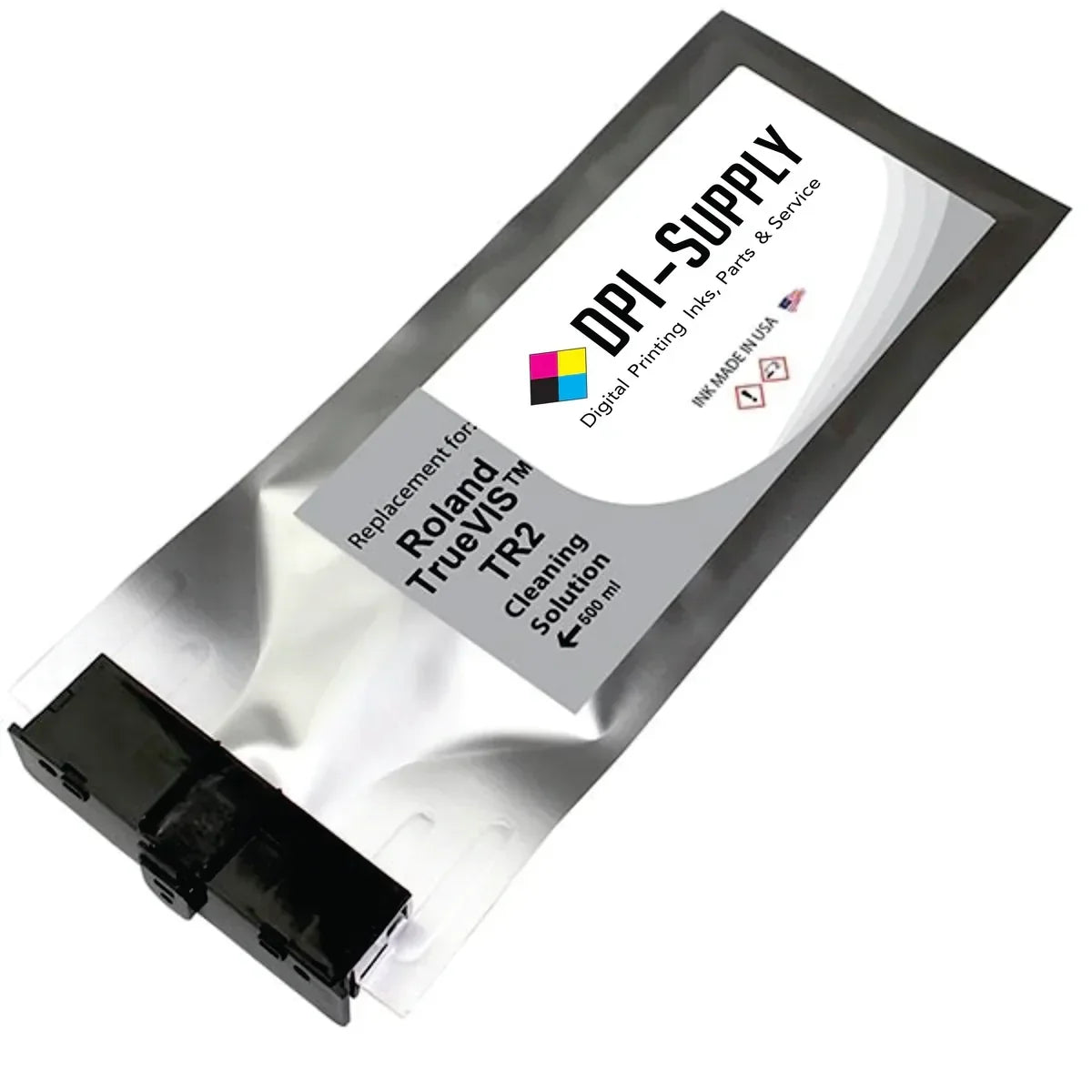
Roland’s TR2 line uses 500 mL pouches and is offered in CMYK plus expanded-color options depending on printer configuration. If you are shopping for TR2 Replacement Ink, match the exact printer model and current color configuration before comparing anything else.
Start With Printer and Ink Compatibility
Compatibility is the first filter because “eco-solvent” does not automatically mean interchangeable. A replacement ink should be specifically intended for the Roland TrueVIS system you operate, not simply marketed as a general Roland-compatible solvent ink.
Ask whether the ink can be introduced directly, whether flushing is required, and whether existing profiles usually remain usable. A well-matched Roland TR2 Replacement Ink should make the transition as uneventful as possible.
Monty’s advice to customers is direct: with the alternatives he trusts, “you don’t have to do anything other than put them in the printer.” He also stresses that the manufacturer has to match OEM color closely enough that a shop does not suddenly spend hours correcting jobs that printed correctly before.

Who Makes the Best Replacement Ink Cartridges?
There is no single best replacement ink manufacturer for every shop, printer, and application. The better question is which manufacturer has a stable formulation, proven compatibility, consistent batches, responsive support, and a supplier willing to stand behind the product.
Monty learned that early in his digital-ink career after trying inks that did not perform well enough. During Roland technician training in 2018, a conversation with a distributor led him to STS, a manufacturer he later tested and began selling.
DPI Supply currently offers its Roland TR2 Ink replacement line and JetBest TR2 bags. Manufacturer reputation matters, but so does the seller’s ability to help when something does not look right.
Are Off Brand Ink Cartridges as Good as Name?
Some are. Some are not even close.
Third-party ink is a category, not a quality level. Monty says his turning point came when he saw alternative inks deliver the color and outdoor durability he expected from OEM products. He has since sold what he describes as tens of thousands of gallons of ink, while continuing to reject products that do not perform well enough for him to sell confidently.
Evaluate alternatives with side-by-side prints on media you actually use. Compare gradients, brand colors, solid fills, adhesion, scratching, drying, and repeat jobs. DPI Supply’s guide to Roland TrueVIS TR2 replacement ink vs OEM ink provides a more direct OEM-versus-compatible comparison.
Compare Color Before You Compare Price
Color problems can erase ink savings quickly. If a replacement changes a customer’s logo color enough that you must rebuild files or reprint jobs, the lower pouch price is no longer the whole story.
Monty says the manufacturers he works with have done a strong job matching OEM gamut, which is why many customers can switch without seeing a major shift. Roland emphasizes the expanded color capability of TR2 itself, especially with Green and Orange configurations, so its official TR2 ink overview gives you a useful OEM baseline before testing an alternative.
Run a Real Production Test
Do not test one colorful sample and call it good. Print repeat customer files, small text, gradients, large solids, photographs, and the media that tends to expose problems in your shop.
Save those prints and compare again after several weeks of production. Long-term consistency tells you more than one good afternoon.

What Brand of Printer Ink Lasts the Longest?
“Lasts the longest” can mean how stable the ink remains in production or how long the finished graphic survives outdoors. Those are separate questions.
Roland states that OEM TR2 can provide up to three years of outdoor durability without lamination under its stated conditions. A third-party supplier should be able to explain its durability expectations rather than simply saying its ink is “the same.”
Think about what you print. A short-term event banner does not carry the same exposure risk as a fleet graphic or exterior sign. The right Roland TrueVIS TR2 Ink alternative should match the lifespan your customers are actually buying.
Which Printer Brands Allow Third-Party Ink Cartridges?
Third-party options exist in the market for commercial printers from Roland, Mimaki, Mutoh, Epson, and others, but “available” does not mean manufacturer-approved. Check your warranty, service agreement, ink delivery system, firmware, chips, and exact compatibility before switching.
Monty has worked with multiple printer brands from the technician side. His view is that shops should make the decision based on evidence instead of assuming OEM is automatically the only workable option or that every compatible pouch is equivalent.
Calculate the Real Cost Per Print
A low purchase price is easy to compare. Real operating cost takes more work.
Include ink cost per milliliter, wasted prints, cleaning cycles, profiling time, operator time, media waste, downtime, and the possibility of premature component replacement. Monty often makes the same point about very cheap ink: it stops being cheap if poor performance leads to expensive printhead problems.
He has also seen alternative ink deliver meaningful savings. One customer, Frank at Specialty Print, was buying large OEM Mimaki SS21 bags when another price increase hit. Monty offered an alternative at a dramatically lower price, and the customer was thrilled because the savings did not require accepting unusable output.
That is the standard to use with TR2: savings plus dependable production.
Maintenance Matters No Matter Which Ink You Buy
One of the easiest mistakes is blaming ink for a maintenance problem or blaming the printer for neglect. Whether you run OEM or replacement ink, the machine still needs routine cleaning.
Monty and two technicians he works with use a simple rule: “Did you run it? Clean it.” If the printer ran today, clean the appropriate maintenance areas today rather than waiting until the end of the week.
Fine ink mist and bounce-back can collect around the printhead carriage and other areas. Regular cleaning helps protect consistency, and even a quality alternative cannot compensate for a poorly maintained printer.
What Should You Ask a TR2 Ink Supplier Before Buying?
Before switching, ask practical questions:
- Is this ink compatible with my exact TrueVIS model and color configuration?
- Can I switch directly, or does the printer need to be flushed?
- How closely is the color gamut matched to OEM TR2?
- What outdoor durability should I expect?
- What support is available if I have a chip, pouch, or color problem?
- Has the ink been tested over months of production?
Monty stays current by attending trade shows and talking with other people in the industry, including competitors. That matters because inks, firmware, printers, chips, and production methods change. You want a supplier that keeps learning after the sale.
The Best TR2 Alternative Is the One That Keeps Production Predictable
For most shops, the goal is not to prove that OEM ink is bad or that third-party ink is always better. The goal is to lower operating cost without creating a new production problem.
That is why the best comparison combines price with compatibility, color, durability, maintenance, supplier support, and your actual application mix. Test before making a large commitment, maintain the printer daily, and judge the ink by what comes off the machine over time.
Monty’s experience is a useful reminder. He has seen weak alternatives, but he has also seen compatible inks deliver the results that convinced skeptical customers to keep buying. The right choice should earn that confidence through consistent output, not just the lowest number on a product page.